Project Overview
The Raw Materials Research and Development Council (RMRDC) has initiated the design and local fabrication of a 50 kg/day freeze dryer tailored for preserving fruits and vegetables. The project brings together a multidisciplinary team of engineers and food scientists from the RMRDC, the Centre for Food Technology and Research at Benue State University, Ahmadu Bello University (Zaria), and TDD Engineers. The goal is to produce a robust, energy-efficient freeze dryer that can be built from locally available materials and controlled with a reliable electrical control system to guarantee product quality and consistent performance.
Timeline & Location
Timeline: January 2025 – March 2026
Location: Benue State University (primary test and evaluation site)
Current Status: 65% completed — design phase advanced; prototype fabrication underway; preliminary component integration commenced.
Objectives
Design and fabricate a scalable 50 kg/day bench-to-pilot freeze dryer using predominantly locally available materials and components.
Develop an electrical control and instrumentation system to precisely regulate temperature, vacuum pressure, defrost cycles, and safety interlocks.
Test and evaluate dryer performance against metrics: drying time, moisture reduction, energy consumption (kWh/kg), product rehydration quality, nutrient retention, and shelf stability.
Produce a validated technical dossier (design drawings, bill of materials, control logic, SOPs) suitable for replication and commercialization by local fabricators.
Project Team (Lead Contributors)
RMRDC — Project coordination, specifications, and commercialization pathway.
Centre for Food Technology & Research, Benue State University — product selection, sample preparation, quality analysis, and sensory evaluation.
Department of Engineering, Ahmadu Bello University, Zaria — mechanical and thermal systems design, materials selection.
TDD Engineers — prototype fabrication, refrigeration & vacuum system integration, electrical control programming.
Scope of Work / Key Activities Completed & In Progress
Completed (to date):
Requirements analysis and capacity specification (throughput, product types, target moisture content).
Conceptual and detailed mechanical design for chamber, shelves/trays, condenser, and condensate collection.
Selection of refrigeration and vacuum pump specifications suitable for 50 kg/day throughput.
Preliminary electrical control architecture and selection of sensors (thermocouples, pressure transducers, flow switches).
In Progress (current):
Fabrication of prototype chamber, shelf frames, and condenser assembly.
Procurement and integration of refrigeration and vacuum subsystems.
Development and programming of PLC/embedded controller interface and HMI for process control and data logging.
Preparation of standard operating procedures (SOPs) and safety protocols for pilot testing.
Planned (next):
Commissioning, instrument calibration and dry runs (no product).
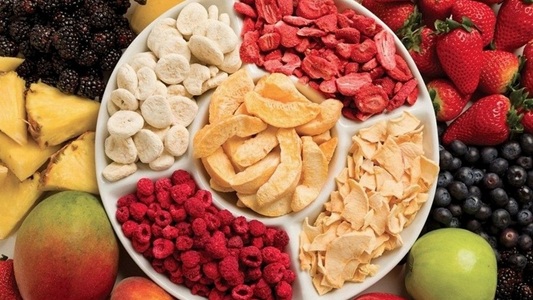
Pilot drying trials using representative fruits and vegetables (e.g., mango, pineapple, tomato, pepper).
Performance evaluation and optimization cycles (adjusting shelf temperatures, vacuum profile, primary/secondary drying times).
Energy efficiency assessment and identification of opportunities for local energy optimization (e.g., waste heat recovery, load scheduling).
Performance Metrics & Success Criteria
Achieve 50 kg/day effective freeze-drying throughput under defined batch cycle times.
Target residual moisture and water activity levels appropriate for long-term shelf stability (per product benchmarks).
Energy consumption target: competitive kWh/kg compared to small-scale commercial units (to be quantified during trials).
Product quality: acceptable rehydration ratio, colour retention, nutrient (vitamin) retention within acceptable loss thresholds, and favourable sensory scores.
Robustness and maintainability: use of locally replaceable parts and documented maintenance procedures.
Deliverables
Fully functional 50 kg/day freeze dryer prototype.
Electrical control system with PLC/HMI, data logging, and alarm handling.
Design package: engineering drawings, wiring diagrams, control logic, parts list, and procurement guidance.
Validation reports: performance, energy, and product quality test results.
SOPs, maintenance manual, and commercialization/scale-up recommendations.
Risks & Mitigation Measures
Risk: Delays in specialized component procurement (vacuum pumps, reliable compressors).
Mitigation: Source alternative local equivalents; stage deliveries; incorporate modular interfaces to allow future upgrades.
Risk: Energy-intensity impacting operating cost.
Mitigation: Evaluate energy-saving measures (insulation, variable-speed drives, off-peak scheduling) during testing.
Risk: Technical skills gap for local fabrication/maintenance.
Mitigation: Include hands-on training modules for local fabricators and technicians and develop clear maintenance manuals.
Socio-Economic & Strategic Impact
Value Addition: Enables local preservation of perishable produce, reducing post-harvest losses and increasing farmers’ incomes.
Import Substitution: Reduces dependence on imported freeze-drying equipment by providing a locally fabricated, cost-effective alternative.
SME Development: Stimulates small and medium enterprise opportunities for local fabricators, service providers, and food processors.
Nutrition & Food Security: Preserves nutrient-dense foods for off-season consumption and longer-term storage.
Technology Transfer: Builds local engineering and food-technology competencies, supporting RMRDC’s mandate of translating research into industrial applications.